Monday, September 28, 2009
Crime and Punishment (revised)
There is no question about it, Belize does have a crime problem, particularly murders, in Belize City. Many of them are in Belize City, but occasionally it will spill out of that community into the communities west of it. I think there are several causes. The country of Belize has a small population, and Belize City is the only even moderately large city, so the crime there skews the numbers for the country as a whole.
First, there is a big community of Belizeans in Los Angeles, California, and another in New York.There are people who travel between those cities and Belize, bringing elements of culture of those cities. As I read about the senseless killings in the paper, I occasionally see references to gangs, specifically the Bloods and the Crips (?), which are notorious gangs in LA. There are a lot of young men in Belize City who are un(der)educated, un(der)employed and are fodder for gangs. So I think there are gang against gang killings, and there may be initiation killings.
There is a growing sense of frustration in Belize City about it, even this weekend there was a “peace march” there to protest the violence. In the meanwhile, although the police frequently catch the perpetrators, they rely heavily on eye witnesses. But Belize is small country (see below), and it’s said everyone knows everyone, and witnesses often fail to appear at the trials, presumably because they have been threatened or just intimidated, so the murderers go free.
Although, I my view, alcoholism is rampant in the whole country (except, I believe, among the Mayans), Belize City is also the center of hard drugs. So armed robberies are not uncommon, frequently drug related, but if there is anything different about Belize from the western world, it seems to be a willingness to shoot.
Belize has a very small military, unlike other Central American countries, and they don't get involved in law enforcement. (Having traveled in Mexico and Guatemala, I don’t mind not having trucks with mounted machine guns patrolling the roads.) Belize is not a wealthy country by a long shot, and outside of the “cities”, the police are hired and trained, and answer to, the national government. There are not nearly enough of them to deal with the problem, nor are they given the resources they need. The Judiciary seems competent, but they can't do much without evidence or eye witnesses.
(A word about the population of Belize and the impact on national resources. Belize is the size of New Jersey, which is the most densely populated state in the US at 452 persons per square mile. Belize, on the other hand, ranks 170 in a list of population density of 192 countries, with a density of 31 persons per sq. mile. For comparison, neighboring Honduras has 161 p/sq/mi, Guatemala has 348 p/sq/mi, and Mexico 139 p/sq/mi. This means there is a small population base to provide taxes to support the government. Although wages in Belize tend to be higher than surrounding countries, they are still low. We attract and keep good workers on our construction crews because we pay well – masons earn $75/day. With a generally poor local population, there is not a strong base to support the government, so programs like police protection are not supported as much as they need to be. In fact, we had a spate of boat motor thefts here in Placencia, and the local police came to our Rotary club asking for funds to fix their boat so they could patrol and pursue.
20% of the country’s population lives in Belize City. The most significant crime belt is from Belize City west through Belmopan, Cayo and Benque Viejo del Carmen. Those four communities have 35% of the population and probably in excess of 50% of the violent crime.
Before I came to Belize, people who had come here would tell me they didn't like it. I would ask them if they had come on a cruise ship, and they would answer yes, which is all I needed to hear. The cruise ships stopped at Belize City, and people who did not take excursions by bus to attractions in the country, but stayed and wandered around in Belize City, saw the worst of Belize. People here in Placencia express fear that when the road is paved all the way to the Southern Highway that thugs will come down from B.C. I tend to doubt it - it is a 3 hour drive, but the improved road will make a difference.
I should also note that the violence tends to be among people in certain neighborhoods, and you rarely hear of any tourists or expats being targeted. In fact, there is a division of the police called the Tourism Police, and they not only look out for tourists, but also insure that tour operators are qualified and licensed to provide the services they offer. So tourists and expats are safe provided they don’t walk around bad areas of Belize City at night – and that can be said for many, many cities around the world.
The most rampant crime in our area is petty theft of opportunity. I always lock my truck, even if I'm going into the bank or a store for a minute, but I did that in Maine, too. Most people with items of value in their homes will have bars that go over windows, and metal gates at their doors, to prevent break-ins. People leaving their Belize homes for extended periods will often find someone they trust to stay at their house.
Fraud is so common it is almost taken for granted. The previous national government left office in disgrace, with millions of dollars missing or unaccounted for. The current mayor of Belize City, as well as other local officials, has been arraigned on charges related to $275,000 missing as a result of a practice they called “underdepositing of funds”. This stuff is in the news constantly, and it doesn’t seem that anyone goes to jail for it, and I think it filters down the food chain so to speak. It is not unusual for tradesmen to request full payment for a job before completion, and then disappear. Would you go along with that wherever you are now? Probably not, and there is no reason to do so here.
I've recently read some good stuff about the prison at Hattieville. Seems that they have a good program for training inmates in making crafts that are in demand, and so the recidivism among that group is very low. When Bob and I went to Belize City to go shopping, we stopped at the prison store. There was very little there, but there were some amazing carved doors and other large carvings.
If you have read this blog from the beginning, including my drive through Mexico, you know I don't speak Spanish, and that I was led through that country by a Mennonite driving a truck that attracted the attention of the police. They would pull him over, and I would pull in behind him. He would speak/argue with them in Spanish, and usually one or two would come speak to me. I led off the conversation with, "No habla espanol." End of converstation. If I had gotten into trouble requiring police protection or assistance, the language barrier would have been a real problem. Belize is an English speaking country, but Spanish is also spoken widely. So English and Spanish speakers have a definite advantage in any contact with the police.
Finally, I don't mean to create a negative impression of Belize, but the reality is that crime exists here as it does everywhere. I live in a resort area, adjacent to a village marked by poverty. On almost every trip to and from Placencia village there are people looking for a ride. I have no hesitation to offer rides, and if there is room, they ride in the cab of my truck with me. I know several by name. I feel perfectly safe, but I do lock the doors to my apartment and truck when I am not in them, but that was true in Maine as well.
So if you come to Belize to visit, don't go to Belize City, there is very little to see. You are safe if you take the same precautions you would take anywhere you travel.
Sunday, September 27, 2009
Entertainment options
For longer trips, Guatemala and Mexico’s Yucatan Peninsula border Belize.
For those of us who live here, and who have limited budgets, and especially for those who work, entertainment options are more limited. There are no movie theaters, no lectures, no bookstores. The only nightlife is the bars, which I do not frequent. That leaves internet, TV, or early to bed.
Internet here is high speed DSL, which means not nearly as fast as broadband cable. It can also be somewhat problematic – my connection here at the house has been erratic for several days – so erratic I am composing this post in Word, and will copy and paste it into the blog when I can get on line.
TV is via the local cable company (which has been promising internet for a long time). I think their cable signal is from a Direct TV satellite(s), and the channel lineup can be pretty “interesting”. My biggest disappointment is that it does not include a U.S. PBS link, since most of my limited viewing in the US was of PBS news and documentaries. What do we get? Well we have about 10 kids channels, and then standard ones like Discovery, History, Food, Travel, HGTV, TV Land, ESPN and ESPN2. There are channels for each of the broadcast networks: ABC, NBC, CBS and FOX. There are the cable news channels: CNN, HLN, C-SPAN, MSNBC and CNBC. Lots of movie channels, you know what they all are, so I won’t list them. The oddities to me are channels like GSN – the Game Show Network, which is nothing but game shows. And SOAP, nothing but soap operas. The 4 local channels all have their slots, but aren’t necessarily on the air at any given time. As I’ve mentioned before, the English version of Al Jezeera is a good source of international news, much less sensational in its approach than the US networks.
There is a channel called RFD, which has shows like “Cattleman to Cattleman” dealing with livestock issues. There is an International Soccer channel, followed by GOLTV, which is also soccer 24/7. MTV, VH1 and CMT are all there, as well as several channels that actually show music videos. There is a fitness channel. Then we climb into the regional channels and beyond. There are Mexican, Guatemalan, and Honduran channels (all in Spanish, of course), including music video channels, and CNN Espanol, which has different stories from the US CNN. There is also Fox Sports Latino, and movie channels with Spanish language films. Then there is CCTV4, a channel from China that is programmed for Chinese living in other parts of the world. There is also a channel from Taiwan, as well as two from India. The Indian channels have movies with lavish sets and weeping women.
One of these 115 channels is the local cable’s channel, which lists local coming events, death notices, and what the channels are. There is no channel telling the viewer what programs are being broadcast. No way to know what movie is coming up. No way to know who the soccer teams are that are playing or will be. The Spanish channels seem to have more attractive women wearing sexy clothes than the US channels.
I am glad I brought a variety of DVDs, my music collection, and a lot of books. I did not catch on to The Office or 30 Rock until the last weeks I was in Maine, so I brought with me one season of each on DVDs, and have since gotten more. I’ve really been enjoying them, and haven’t yet resorted to seeing what DVDs local vendors are offering.
They do offer the kids programs from PBS during the day, and when I first got here they had the PBS News Hour. However, they lost the signal so frequently that I gave up watching it, and now it is no longer offered. As I write this, the cable system has dropped the signals from about 15 stations across the spectrum.
A last option I should mention is Sirius satellite radio. I have it hooked into my stereo system, and it has a couple of NPR talk stations, so I can listen to Prairie Home Companion and other programming I enjoy.
I’ve linked into the community through my membership in the local Rotary Club, and the Volunteer Fire Dept. I’ve also started a “dinner group” to go to the local restaurants every month, although we have yet to do so.
So that’s the entertainment side of “lifestyle” here in Placencia – questions?
Sunday, September 20, 2009
A free press
I’ll start by noting that I have a subscription to the online version of the New York Times, which includes every page of the newspaper, 7 days a week. Over my morning coffee I read what interests me on the front page, and follow those stories on the inside, check the highlighted stories on the next couple of pages, and then read the op-ed page. That’s my source of U.S. and international news.
Here in Belize there are no daily papers, and the best paper, Amandala, comes out Tuesdays and Fridays. It is the most widely circulated paper, and was started in 1969 by a local Creole when he returned after graduating from Dartmouth College. From his editorials, I’ve learned he was a black power advocate, although he has tempered with age. That said, everything he writes ends with the phrase, “All power to the people.” The paper has no reservations about ferreting out corruption, regardless of the political affiliation of the culprit. The last government made some secret deals with a British Lord who has extensive business interests in the country, notably with the telephone company, which he owned. They promised him a guaranteed rate of return, and permission to block VOIP (Voice Over Internet Protocol). The then Attorney General signed the documents. The new government uncovered these shenanigans, and the former A.G. claimed he knew nothing about them. So Amandala published the documents, with his signature.
Here’s a scan of the top of the front page of the current issue, with a headline about $275,000 in unaccounted for funds from the Belize City City Council (CitCo). This type of wrong doing is exposed constantly, but there are times I feel like it pervades all levels of society, so it is not unexpected, and as a result the culprits don’t slink away, but defend themselves with explanations like the mayor’s in this case – that the supporting documents to prove the legitimacy of the expenses are in a file that was stolen from the office occupied by the auditors, although it was the only thing stolen and the theft was not reported. There is a certain entertainment value to reading these stories.

Amadala has also published books as serials about the history of the Cuban revolution, and about the influence of the Guatemalan military on the government and culture there, among others. The current issue has an article reprinted from the Miami Herald about Miguel d’Escoto Brockmann, who recently served a term as President of the U.N. General Assembly. He is a devoted Sandinista. While the paper is not necessarily anti-US, it will point up inconsistencies in US policies as they relate to Belize.
There are also several other papers, one independent, and one each affiliated with the two political parties. When I can I buy the other independent paper, The Reporter, because they sometimes have local news the Amandala doesn’t.
The papers are all produced in Belize City, and getting them in Placencia can be hard. Amandala used to be sold at a small insurance office I pass on my way to work, but they discontinued it because they did not sell enough of them. So now the only source is to get them from Mr. Brown, who rides his bike through the village selling them. It took some doing, but now he remembers to bring them up to our office. He charges $1.65 for the $1.35 paper, but it is well worth it. I spend more time reading one Amandala than seven New York Times.
The closest printed matter to a news source in Placencia is the monthly Placencia Breeze put out by the local tourism bureau. Other local news is more on the order of announcements that the TV cable company puts on the channel they use to show which cable channels are at which numbers, and their shut off date for late pays.
Belize national news is also available from the three Belize TV channels. One was recently purchased by that British Lord mentioned above in relationship to the phone company, another I also don’t watch, and the third, Channel 7, has a fairly good presentation of the news. It is an hour long, and stories tend to go on and on when they have done on site reporting. Reports are broken by death notices, during which funereal music is played while a photo of the deceased is on the screen, and many of the relatives, both in Belize and in the US are listed. Sometimes, the deceased, and almost all the relatives, are in the U.S., primarily in Los Angeles or New York. When they end their newscast, which is only broadcast Monday through Friday, they switch on NBC national news. They replay their broadcast later in the evening.
There are links to the online versions of print media and radio and TV news at www.belizenews.com. I referred to those links for several years before moving here.
I started this post with a reference to a free press. I wonder if the press in other countries in this region are as free to expose wrongdoing by government officials and business interests as the press here in Belize. I would guess not, and for that I’m grateful to be in Belize.
Saturday, September 19, 2009
A trip to Spanish Lookout
I should note before rambling on that Spanish Lookout is a Mennonite community. It is very prosperous, clean, and largely agricultural. There is one oil well in Belize, and it’s in
Spanish Lookout. We saw a few horsedrawn buckboards, so there is even diversity within the Mennonites, since we saw just as many all terrain vehicles being driven on the roads. Many women store clerks wear a black headpiece on the backs of their heads. It is probably the greatest concentration of white people in the country, although there were many Mestizos and a lesser number of Creoles mixed in.
We left there and went to a business that supplies equipment to the butane gas industry. Bought some valves for our butane distributorship, and a kit to convert my truck. Why convert? The price of gasoline here is $8.73 BZD a gallon, so the 260 mile round trip cost slightly more than $150 for gas. If I paid retail for butane, it would cost me $5.75/gal., but it actually costs me less because one of our businesses is a butane distributorship. I’ll get about 20% less miles per gallon, and the setup will allow me to burn butane or gasoline with the flip of a switch. It will be installed by the mechanic for the butane business. It’s also cleaner burning than gasoline. I also got a 30 gallon used tank, and with our company discount, the whole rig cost a little less than $1000 BZD. I’ll save that in the first year.
We then went to the local “Farmers Trading Post”, which is the best supermarket in the community. Was still a disappointment compared to Brodies in Belize City. Just the same, they had the kind of chocolate pudding that has to be cooked, so I bought 8 boxes. Had not found that kind anywhere else in the country, so it was a great find. From there we went to a health food store Bob had heard about – he takes lots of supplements. In addition to hundreds of supplements, they had maple syrup from Canada, Tom’s of Maine toothpaste, and Arrowhead Mills Rye flour. I had brought a supply of maple syrup with me, but bought the latter two. When we left I took a picture of their store:

And then took pictures of the landscape looking east
And west toward the hills in Guatemala...

From there we went to lunch at the Golden Corral restaurant, which contained a microcosm of Belizean ethnic groups. Then on the Western Dairies ice cream stand. They are the supplier of dairy products in the country, and I got a 2 scoop cup of butter crunch with chocolate sauce for $3 BZD. A good deal! Met our employee Keila there, with her baby, baby sitter, and boyfriend’s mother. Then followed her back to their house, where the mother has a pet spider monkey. That’s another story.

Then we headed back home, with an errand stop in the capitol “city”, Belmopan. The drive from Belmopan south along what is called the Hummingbird Highway is really quite beautiful, although there are no turnouts to stop and take pictures. You pass through mountainous jungle country, with steep sided hills with dense growth falling down to the road
In all, a good trip through some beautiful country. Of course, I can't end without mentioning the sky - clouds here tend to be the big cumulous clouds, and on the way north at 6:30 AM they were backlit by the rising sun. Later on an otherwise sunny day we saw a partial rainbow formed below a cloud in the distance. The late afternoon light in the mountains made them even more spectacular.
Made my first box of chocolate pudding that night.
Tuesday, September 8, 2009
Still alive...and well.
Tonight I have to use a tutorial disk to learn the program that the local Rotary website has now been converted into. It is supposed to be easy to use so we'll see.
Tomorrow morning I'll be helping to present dictionaries to kids in the Seine Bight School. for many it will be the first book they've owned. I'll be photo documenting it, and will post here within the next night or two. Now, the tutorial...
Sunday, August 23, 2009
sky and schools
( I will note at this point that last week, I spent an evening responding to that query as well writing a long missive about the food here, and then it evaporated in cyberspace or in my computer’s innards. It was frustrating after spending a evening on it, I am just now getting back to it. And this one I have created in Word, and will transfer to the site.)
What I like most about Belize is the sky. It is really incredible. We are in the rainy season, which means more clouds than usual, usually bringing rain sometime between midnight and 5 AM. I go up on the roof every night to watch distant lightning, or after my eyes have adjusted, to look up at the milky way, and millions of stars. This morning I woke up at about 5:30 and the sunrise was so spectacular I grabbed my camera and went up on the roof and shot this picture of the sunrise.

Then I looked west, and took this picture of a cloud in the west that was catching the sun.

This evening I took this picture of the sunset.

I know, I know, I’ve posted lots of sunsets and clouds on this site. And the pictures I post, while pretty, don’t really do justice when you consider that I’m only taking a picture of a small slice, although a relatively big one with the lens I’m using, but still a small part of this astonishingly beautiful scene from horizon to horizon.
About the local schools – The schools in Belize are a church-state partnership, which means no one really takes responsibility for the results. The church is either the Anglican Church or the Catholic Church, depending on the local school. But these aren’t schools connected to a local parish, they are connected to the national church in some way. The “state” is the national government.. But it gets worse.
The schools generally sit on land owned by the church. The school buildings are built by the state. The teachers are hired by the church, but are paid by the state. The teachers have to belong to the church, in part because they teach religion in the schools. The state is currently trying to start a commission to review teacher qualifications and get involved in the hiring process, but the Catholic Bishop is very resistant.
I’m not sure if the principal is hired by the church or the state. Our Rotary Club painted all sixteen classrooms in the Seine Bight school this weekend, which how I learned this info. In my discussion with the principal, I asked him if they taught evolution in science, and he replied that they encourage teachers to keep their opinions out of the classroom, which tells me that he is hired by the church.
Here is a picture of the school.

Belize is a third world country, and the primary taxes are a 10% sales tax on most things, business taxes based on gross receipts and duties on imports that can be as much as 34%.
The government struggles to build the infrastructure the country needs, and support a population, many of whom live in poverty, which includes many residents of Seine Bight. There is no such thing as local property taxes, so there is no local financial support that isn’t voluntary.
I say this because the state pays the teacher salaries, but not much else. It is up to the principal and teachers to raise funds for classroom materials. I looked at textbooks in two rooms, both were textbooks about the United States, both dated from the late 70s. The school is concrete, the rooms are boxes without anything to baffle sound, and I am sure are extremely noisy when occupied. The floors are unfinished concrete.
On the other hand, one of our clients is a family from Edmonton, Alberta, a major city in Canada. They have a daughter in the Seine Bight School, and are pleased with the education she received last year, and felt it compared favorably with Edmonton schools in many, though not all, ways.
Keila, our autoCad technician, came up through the Belizean school system, and has done well by it. I will try to remember to relate it on the near future post. And I’ll (re)write about food!
Thursday, August 13, 2009
I become a fireman...
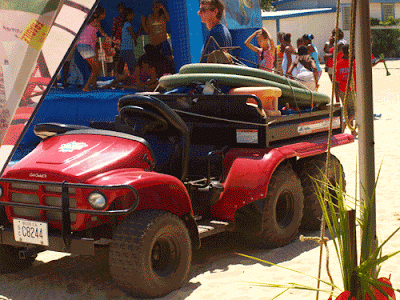
This is actually a very practical rig, especially in Placencia village, where a major fire destroyed several businesses and homes several years ago. It was fought with a bucket brigade. This machine can travel on road or beach, basically to get the pump to the water's edge, where it can be set up, and we carry enough hose to go about 200' . That's not far enough where the peninsula is wide. We need some form of a tanker truck, as well as a lot of other equipment. So you may be asking yourself - why doesn't the town have a fire dept?
Well, the issue goes back to Belize being a backwater British colony. Large tracks of land were granted to the English elite when the colony was primarily a source of mahogany. Property taxes were kept very low for these absentee owners, and the primary support for the colony came from import duties. That tax structure remains the same today. The national government is the only taxing authority. I've priced out having my restaurant directory printed in the states, where it can be done much cheaper than here, but when you add the 10% General Sales Tax plus the 34.795% import duty, the playing field levels out. The duties help support the government, and also stimulate manufacturing in the country.
Although there are village councils, they are dependent on the national government for funds. And there aren't many - it is a poor country, and they only support fire departments in the bigger towns. For us, that's Dangriga. It took their truck an hour to get to the big fire here a couple of years ago. That's when the Placencia Rotary Club sprang into action, and formed the VFD, and remains its primary means of support.
Back to last Sunday. We trained, which meant about 6 of us, set up the pump, ran out the hose, and pumped a little water. It was useful to me to learn how it was all supposed to be set up. But it wasn't useful on Monday.
I started home from work at 5 or so, and as I was passing through the village, dodging pedestrians, bicycles, dogs, kids, and the occasional car or truck, I heard someone yell, FIRE! I looked at the source of the holler, and a member of the dept called out that there was a fire about 2 miles north of town. I got through the village as quickly as possible in the described conditions, and headed north - which is the way home. A few minutes later I found a woods fire on both sides of the road - the woods being palms and scrub growth. There were 3 or 4 people fighting it with shovels and a five gallon bucket, and the truck wasn't there. Since I was wearing sandals and shorts - not ideal for fighting fires, I rushed the mile home, changed into jeans and my most protective footwear - sneakers, grabbed the only implement we had, a pitchfork, and headed back. Met the truck, which was trying to find access to the beach. The effort proved futile, the fire was out of range of our hose. Fortunately, on the ocean side of the road there was a lot of standing water because it is the rainy season, and the wind died at about 6:30, so we were able to snuff it out. We thought another crew had snuffed the fire on the lagoon side, but as I headed home at 8 or so, there was still active fire, so I and another guy put out what we could see.
So I joined and trained on Sunday, and fought a fire on Monday. Now I'm working to see if I can locate used equipment in the states that can be shipped. We didn't even have axes or saws to cut down the palms that had fire in them. No Indian pumps. This certainly is a land of opportunity!
We lose a good man..
But the cancer took him. He returned to his roots in the west earlier this summer, and on Monday I received an e-mail that he had passed away last Sunday morning. It was a shock - he had remained so positive about his prognosis, and you don't want to believe that someone who had as much life in him as Tim did could go before he had finished doing what he wanted to do.
I should note that he came up with the name for this blog. I wanted to use saltydog, but it was taken, or saltydogchronicles, but that's been done, and it is a bit of his humor that brought out saltydogtales. Thanks Tim, wherever you are!
Tuesday, August 4, 2009
Feet X 2 + $ X2
Belize is the former British Honduras, but little remains of that culture, like the metric system, which is not used here. I suspect because of the preponderance of Canadians temperatures are referred to in Celsius rather than Farenheit at least in conversations I've been in. But I'm in the construction business, among others, and measurements are in feet and inches.
And speaking of feet, for many years I have taken off my shoes in my office and been in my stocking feet. Now that I wear sandles all day, I take them off as well, and work barefoot. Must say I really like it. My feet are getting tougher, so walking in the driveway the pebbles are barely noticable. The most prominent barefoot person in the village is the owner of Wassen's Store, which sells groceries, housewares etc etc as described in the last posting. He's also the president of our Rotary Club. I have never seen him with shoes on. There seem to be no rules about being barefoot or shirtless in stores, restaurants or anywhere else. It does surprise me to see so many Creoles wearing sneakers or boots. Of couse many are barefoot, as well. Most ex-pats seem to wear flip flops. Although I shower every morning, I think I'm going to have to soak my feet at some point to truly clean them.
The exchange rate between Belize money and US is 2 to 1, 2 Belize dollars to 1 USD. Belize does not have a $1 bill, instead having a $1 coin that is brass in color and is an octogon. They also have pennies, nickels, dimes, quarters and half dollars. That said, you rarely see pennies, dimes or half dollars. I say this based on some experience, because I have to process the receipts of the butane business and the bus line, so a lot of currency passes through my hands. People have so little use for pennies that storekeepers rarely give them in change - they round off to a nickel. Change in my pockets illustrates this - I have 6 $1 coins, 3 quarters, 23 nickles and 3 pennies. Belize has $2, $5, $10, $20, $50 and $100 bills in regular circulation. All the money has the queen on it. The paper currency has lots of security features to prevent counterfeiting, but on the other hand, it is made from a soft paper and I think it deteriorates quickly. Tomorrow morning I'll deposit about $3000 BZD and I'm sure several bills will be pulled and taken out of circulation. The bank will take US dollars as well, but if they are ripped or damaged, the bank won't accept them. So I guess they remain in circulation like musical chairs - at some point it is so worn out it can't be used by the last person who gets it. US bills are in circulation here, but coins are not accepted. It is easy for folks who use US currency to visit here because it is so easy to calculate the local cost if you have a pocket full of USD. Other Central American countries are a whole different ballgame.
In fact, Belize is very easy to visit for English speakers, because English is the official language is is spoken my most people. That said, Spanish is also widely known and spoken, so Spanish speakers would have it easy too.
Well, so much for feet and money. Time for bed.
Thursday, July 30, 2009
I couldn't help myself...

As you can see in this picture, even the concrete ones can be swallowed by the earth.
One of the Rotarians helped with a burial - they hit the water table 1-1/2 feet down, and with some difficulty dug a grave 4 feet deep. When they put the wooden coffin in, it floated, so they had to pile sand on top of it to sink it. What I find very interesting is how death is referred to - people's birth dates and death dates are given - it is their sunrsie and sunset. So my sunrise is April 20, 1945. Unless there is some catastrophy that befalls me, it'll be a while before my sunset, and who knows where that will be.
Enough about death - or sunsets. Here's a picture of two people with interesting stories. The gentleman is Harald, the current president of our Rotary Club. She is Sandi, the immediate past President. Fifteen or so years ago she was hitchhiking around Central America, stopped in Belize, and never left. She manages a local airline terminal at the airstrip, and sells quality shrimp on the side. Harald came to Belize, or should I say British Honduras, 35 years ago. At that time
none of the roads in the country were paved, and in the rainy season it was quite possible to get trapped between rivers when rains in the mountains caused the rivers to submerge bridges. At that time there was a narrow gauge railroad that served the banana plantations. The railroad is no more, but the bridges are still in use as part of the highway - and are one lane wide, probably not much more than 8.5 feet, if that. Harald came because he wanted to be a bush pilot. That didn't happen, but somehow he ended up in Placencia, which at the time was a remote fishing village accessible by boat or a foot trail. Four wheel drive was required, and every week he would buy fish from the fishermen, truck it through the brush up the peninsula, and take it to other towns in the country and sell it. The "road" started in Maya Beach, about 10 miles north of Placencia, and he had a trailer there and would use it as well, bringing back fruit and vegetables and other goods to Placencia. He would have to unhitch the trailer in Maya Beach, and then shuttle back and forth to get the stuff to Placencia. Now he has Placencia's answer to WalMart - his store sells groceries, alcohol, hardware, lumber, appliances, furniture, housewares - and his daughter runs the pharmacy upstairs. They are good people. (Harald and Sandi are not a couple.)
A word about sleeping - For most of my life I've cuddled under a pile of quilts and blankets, warding off the cold. Exceptions in the short Maine summer, though it was only a handful of nights each summer when a sheet would do, or not. Now I go to sleep on top of the bed in my shorts, ceiling fans and a pedestal fan creating a caressing breeze. Occasionally I wake up and have to get under the sheet if it has gotten so cool that the fans are uncomfortable. This time of year I have to keep the east widows closed because thunderstorms can blow through in the night. As I write this the wind is blowing 19 knots with gusts to near 30. In a few minutes when I finish this I will go up on the roof and enjoy the wind, and watching distant flashes of lightning. Then to bed - a truly sensual experience.
Sunday, July 19, 2009
Belize's diversity (continued)
The Garifuna were brought to the “New World” from Africa on two Spanish slave ships in 1635. The ships were wrecked and the Africans were able to escape and settled on the nearby British held island of St. Vincent. Successive generations intermingled with the Black Caribs, who were themselves Arawaks and Caribs from South America. Certain elements of the African culture, such as drum based music, have carried through to the present day. In 1797 the British drove the entire population of Garifuna from St. Vincent, depositing them on what is now Honduras. From there they spread along the coast, with settlements in that country, Guatemala, and in southern British Honduras (Belize). Women are dominant in the culture, historically they were the heads of household, raising food while the men fished. The villages were only accessible by water until recent times.
The biggest Garifuna settlements are Punta Gorda in the south, Dangriga to our north, and Seine Bight, where I am located. British colonial policy had much to do with keeping the Garifuna isolated in their fishing villages, although they are now connected by road with the rest of the country and world, the culture persists.
Several years ago a musician named Andy Palacio was instrumental (no pun intended) in promoting a resurgence of the language and culture. I don’t know if I mentioned it in an earlier post, but when my step grandson Peter graduated from pre-school here at the Seine Bight school, part of the program was having the kids recite various things. They recited the days of the week in English, the official language of Belize, to modest applause, then in Spanish to cheers, and finally in Garifuna, to enthusiastic cheers. It was neat to be there.
Yesterday Bradley and Rilda had a party here at the house, and one of the participants was from the village, in part because he comes over to play volleyball. At 9:30 or 10 he disappeared, then reappeared with a friend and two drums. They were both homemade, but typical in construction. Hollowed out logs with a deerskin drum head on one end, and 3 cords across the head to give a snare effect. One drum was bigger, and was played for a drone effect, while the melody was played on the smaller one. Here’s a photo.

They sang, first in Garifuna, and later in Creol. Several of the Garifuna songs were call and response, either between the two of them, or between them and the rest of us. It was surprising how the melodies were more than coaxed out of the smaller drum. I should note that the smaller drum was played with a higher intensity than the larger one, and they traded drums from time to time.
About ex-pats...
Ambergris Caye, in the northern part of the country, is more highly developed than Placencia, and probably has the greatest concentration of ex-pats, but not having been there, I can’t speak to it. Here on the 15 mile long Placencia Peninsula, there is a growing population some who have been here for a long time, such as my step son Bradley. There are probably as many, if not more, Canadians as Americans, with many from the western prairie provinces. Bradley says I’m learning Creol (aka Kriol) with a Canadian accent. They have either retired here because of the favorable arrangements the government has, or they have come and purchased or started businesses. A young couple I’ve gotten to know have a wine bar/restaurant in Placencia village – they are from California, but will be on an annual vacation in Maine next month. At the end of our driveway is an Austrian restaurant created by a young Austrian couple – here’s her picture from last night’s party:

Their story? He is a trained Marine Biologist, she has a business management background. They were well paid but bored in Vienna, and after some research moved to Australia, where they were involved in the diving industry. However, housing costs were extremely high, and the costs of starting or acquiring a business were prohibitive. So they did more research and decided to visit Belize, which allows a non-citizen to own 100% of a business and the land it sits on, unlike other neighboring countries that limit a non-citizen’s stake to 49%. Ambergris Caye was too busy, and expensive, so they came to Placencia, which is growing fast. They were also attracted to the largest reef in the western hemisphere, just off the coast of Belize. They bought land, built a combination restaurant and home, and opened “The Danube”. So I can walk down the driveway and have “wiener schnitzel”.
The ex-pats tend to be the drivers of the local economy – the ones who have the combination of creative ideas and the courage, capital and business acumen to convert them into reality. I was quite surprised at a semi-annual meeting of the local tourism organization that white people represented at least 80 percent of the (50?) people there.
Although there is poverty here, it is not so pervasive or dominant that it has led to micro-financing NGOs establishing programs to lift people out of poverty. One of the things that drives Bradley is the desire to start businesses that will employee local people and pay them as generously as possible.
That’s it for this post – for more information about the Garifuna, Google the term. To learn more about ex-pats, move to Belize and you’ll be one! It is a land of opportunity for entrepreneurs!
Wednesday, July 15, 2009
I'm back!
The sky continues to be quite wonderful. Although we are in the rainy season, today was sunny, but tonight some rain squalls have passed through. Many nights I've gone up on the roof before going to bed, and watched the heat lightning jump between the puffy clouds in the night sky, with patches of stars as well. Really quite wonderful.
That's it for tonight, more to come!
Thursday, July 9, 2009
Quick post from office

The landlord installed a sill yesterday, and drilled a hole in the wall in the exterior hallway so water would drain off instead of building up. The whole issue goes back to the earthquake - the whole building tilted slightly, about 3" from front to back, not enough to notice, until water flows under the door!
That's it for now - hopefully we'll be up and running at home again soon so I can do a longer post.
Wednesday, July 1, 2009
Honduras
With all the civil wars and role of the military in our neighbors, Belize, as a member of the British Commonwealth, has remained a island (figuratively) of stability in the region. The army, known as the Belize Defense Force, has a facility next to the international airport, but I don't recall ever seeing them anywhere else. Police presence is barely adequate. The contrast between Mexico and Guatemala, and Belize, is quite striking. All that said, here is a piece about Honduras that tells a little more about what is going on than you have probably heard about. I've had trouble posting the title and author of this piece, so here it is in the body of this paragraph: What's Going On - An Insider's Account of the Recent Events in Honduras, by Sophia Anderson.
Honduran President, Jose Manuel Zelaya Rosales, known as "Mel" to most Hondurans, was ousted from power this past Sunday, June 28. In the early hours of the morning, he was woken up by military officers, forcibly taken from his home in pajamas, and placed on a plane headed for San Jose, Costa Rica, where he was placed in exile. Later that morning, the Honduran Congress held an emergency session in which they read and approved a letter of resignation written by Zelaya (although he categorically denies having written it). In the afternoon, according to the succession of power outlined in the Constitution, the President of Congress, Roberto Micheletti, was appointed as interim president until the next election is held in November.
In order to fully understand what is being presented by much of the international press as a gross violation of democracy, one must examine the events leading up to Sunday. Honduras' Constitution currently states a presidential limit of one term. Zelaya has been trying for months to gain support of a referendum vote to modify the Constitution. The desired outcome of this modification includes a re-election and potential indefinite presidential stay in power - similar to dictators such as Hugo Chavez, Zelaya's close political ally, and Fidel Castro.
Furthermore, Zelaya has been widely criticized for his blatant abuse of power and obsession with winning the upcoming referendum vote at the expense of his other responsibilities. Without an approved federal budget in place, Zelaya has been spending government funds at will. Most notably, government workers who had not received a salary in several months due to supposed lack of funds were paid 300-500 Lempiras ($15-25) in exchange for marching in a pro-referendum demonstration. Meanwhile, hundreds of Hondurans severely affected by the May 28 earthquake and thousands more in subsequent danger of flooding from destroyed levees of Ulúa River were completely ignored.
In the weeks before the referendum vote, it became clear that Zelaya did not have legal grounds to hold an election. Although the Constitution can be modified, the Supreme Court declared Zelaya's referendum illegal because the President does not have authority to propose such modifications and, even if he did, it must be approved by Congress. In addition, the Attorney General supported the Supreme Court's decision and declared that he would prosecute anyone involved in carrying out the illegal vote.
Just a few days before the referendum vote, the Head of the Armed Forces, Romeo Vasquez, declared that he would not participate in the logistics of making an illegal election take place (a role traditionally carried out by the military). Zelaya responded by firing him and refused to reinstate Vasquez on the Supreme Court's order. Shortly thereafter, the Defense Minister and Heads of the Navy and Air Force also resigned.
On Friday, June 26, in a desperate attempt to carry out his illegal referendum vote despite widespread opposition, Zelaya led a crowd of supporters to a military compound near the airport in the Honduran capital of Tegucigalpa. They successfully took possession of the country's ballot boxes and distributed them, along with thousands of illegal ballots that had been sent from Venezuela by Hugo Chavez, throughout Honduras for Sunday's illegal vote.
The international community, including the Organization of American States (OAS) and the European Union, has been quick to condemn what they are calling a military coup, while the new administration insists it was not a coup because Zelaya was clearly warned beforehand about the potential consequences if he carried out his illegal referendum vote. Furthermore, the military is not ruling the country. Rather, an interim president has been appointed to govern until the next election in November. The OAS has called for Zelaya to be returned to the Presidency and will hold a meeting in Washington D.C. to discuss the crisis.
The United States, while condemning Sunday's actions as illegal, has stopped short of officially declaring a coup, which would require the U.S. to cut off millions of dollars of aid to Honduras, where over half the population lives in extreme poverty. The U.S. Secretary of State, Hillary Clinton, indicated U.S. reluctance to returning Zelaya to the Presidency when she said, "We haven't laid out any demands that we're insisting on, because we're working with others on behalf of our ultimate objectives." President of the Inter-American Dialogue in Washington D.C., Peter Hakim, summarized the international community's predicament by saying that Zelaya had been "fighting with all institutions in the country" and that "he's in no condition to really govern. At the same time to stand by and allow him to be pushed out by the military reverses a course of 20 years."
In Honduras, there is a sense of tense anticipation over what is to come. Monday, while Micheletti was naming his new cabinet, an estimated 1,500 pro-Zelaya demonstrators were sprayed with tear gas by soldiers attempting to control the protests outside the Presidential Palace in Tegucigalpa. A nationwide 48-hour curfew was imposed from 9 p.m. to 6 a.m. starting Sunday evening and is likely to be extended. Meanwhile citizens throughout the country have been lining up at grocery stores and gas stations to stock up on fuel and supplies as they wait to see what will happen next. As these events unfold, Adelante will continue to support our clients and work to improve the standard of living of the extreme poor.
Sunday, June 28, 2009
Lobsterfest!


As I mentioned in my last post (I think) the lobsters here do not have the big claws the way they do in Maine, and they are caught by divers who break the tails off and discard the bodies when they catch them. I've never seen any signs indicating that they are prepared by boiling or steaming. Today I had a grilled lobster tail for lunch, with rice and beans, and cole slaw. The lobster tail wasn't nearly as tender as I had been used to.

And here's a photo looking down the beach, showing folks sitting in the shade of the palms.


It carries a high volume pump, suction hose, and about 150 feet of 2" canvas fire hose. A major portion of Placencia Village is wooden structures on the beach with no road access, so this "truck" allows the VFD to get the pump to the water, and then run the hose out to the fire. At this time there is not enough hose to reach everywhere, so that is a priority. Another issue is that it is appropriate for Placencia Village, but can take a while to get the Seine Bight, the next village 5-6 miles up the peninsula. So there is effort to have a station there as well, and I will be getting involved in that. Here's a picture of the fire chief, having a good laugh.
I'm told she is a good fire fighter and a good leader. The Fire Dept has a thing people can stick their heads through to have their picture taken, so here's a picture of Jim taking a picture:

Jim is a Rotarian as well as a volunteer fire fighter. I think he is a retired doctor who took advantage of Belize's liberal arrangement for retirees. Here's one of the pictures I took:
Our booth was at the end of a tent, and next to the entertainment tent. That was OK when the steel band was playing :

Monday, June 22, 2009
Who are Belizeans?


This one of Rilda's brothers. All her siblings are attractive.

I think this is one of Rilda's nieces. I've taken thousands of pictures - this one is a favorite!

Another picture from this generation - Bradley and Rilda's son and my grandson Peter.
I'll stop here - it's 10:30 and time for bed!
Monday, June 15, 2009
trucks, food and clouds


Thursday, June 4, 2009
earthquake III
People still talk about the quake - and in Placencia Village the water problems continue. Some time ago I posted pictures of Placencia's sidewalk "street". It is amazing to see breaks in the sidewalk with two parts an inch or more apart, or T joints that now have a substantial gap where there was none before. Apparently in the village of Monkey River, just south of us, which sustained the most damage in Belize due to homes on posts sinking into the ground, the saturated ground turned liquid, and water and mud boiled out of the ground. It must have been frightening for those folks - seeing it by flashlight at 2:30 in the morning.
On other subjects...
I don't think I've ever mentioned how polite folks are here. You are known by your first name - so I'm Mr. Carl. Since I live on the outskirts of the village of Seine Bight, about 7 or 8 miles north of Placencia Village, I usually give rides to folks standing beside the road wanting a ride in either direction. Because I have a cap on the truck, and it is very dirty (from the dust) and very hot under the cap, I let people ride up front with me. They are always appreciative - tonight an old man I gave a ride to would not stop talking, and what I could understand of his creole was that if I ever had any problem he would be there for me. From my perspective, not quite sure what he could do, but a nice sentiment. When I have to move from my present circumstances, I'll probably be living in Seine Bight, so for my own personal security it will probably be helpful to have a cadre of folks I've given rides to looking out for my well being. Bradley routinely gives rides, and is known and well liked by everyone I pick up.
( I originally had comments here about my work, but have removed them to avoid disclosure issues locally. Send me an email if you are interested in my work.)
Well, time to stop writing here and get on with other interests!
Saturday, May 30, 2009
earthquake II


Learned how to set the clock on this blog so it reflected the actual time I post, and your comments now post here as well as arrive in my e-mail - good to hear from you, Tim (Beth&Phil), Val and David!
Thursday, May 28, 2009
earthquake!
And then it did. Very tentatively I moved into my kitchen area and felt around for my flashlights. Found them. What fell in the kitchen? My round pizza stone, which was on the floor on its edge between the fridge and the counter, had rolled out onto the floor, and fallen flat. No problem. I looked around for cracks in the ceilings and walls, there were none. Will there be another trembler? I went back to the bedroom and put on my shorts. Went up on the roof to see how widespread the blackout was. I could see lights in Big Creek, Placencia Village, and Maya Beach, so the blackout was primarily in the Seine Bight area.
I could hear Bradley and Rilda talking downstairs, and Maddie crying. I went downstairs and joined them for a few minutes on the front veranda. Rilda’s cousin Rob arrived on foot. I decided to go back upstairs, and went and got a shirt, my sandals, and sat in a chair out in the central area where the breeze would keep me cool. With no power for the fans, it was getting hot in the bedroom. All the dogs in Seine Bight were barking. Lots of people were calling to each other in the dark. The many fireflies reminded me of my youth.
No more tremblers. I decided to go back to bed, but left my shorts on, and my shirt and sandals in a doorframe by the bathroom. I put on my watch and glasses. I went to sleep.
4:15 AM. I woke to the sounds of the fans starting up, and saw all the little lights on my various electronics glowing blue, red and green. Went to my computer, turned it on and went to the CNN site to find out what had happened. Quake was centered under the Caribbean 25 miles north of the island of Roaton off the Honduras coast. (Later I plotted the epicenter at about 100 miles north-northeast of us.) 7.1 on the Richter scale, there was a tsunami advisory out for Belize, Guatemala and Honduras. Then the power went out again. My radio required 8 “D” batteries, I had 7. I went back to bed.
Woke again at 5;30, and 6:00, and 6:30, or so, with power coming on in fits and starts. I was hot and sticky, and wanted to take a shower before coming to work. At 7:15 the power came on again and stayed on. I got up, showered, and came to work, where I am writing this. Here in the village a water main had broken, and there were cracks in the walls to the building where our office is. Amazingly, cracks in the dirt in the parking lot. Word is that in the village of Independence across the water tower collapsed. The Placencia water tower, a concrete structure which has no triangular bracing, has broken at the joints.
So we’re all safe, but a bit shaken. When I go to bed tonight, I’ll leave clothes in the doorway in case I have to make a nighttime hasty retreat.